How to Choose a Sports Bag Layout for Different Kits
Choose a sports bag layout that suits different kits, protects awkward equipment and keeps the items you need first easy to find.
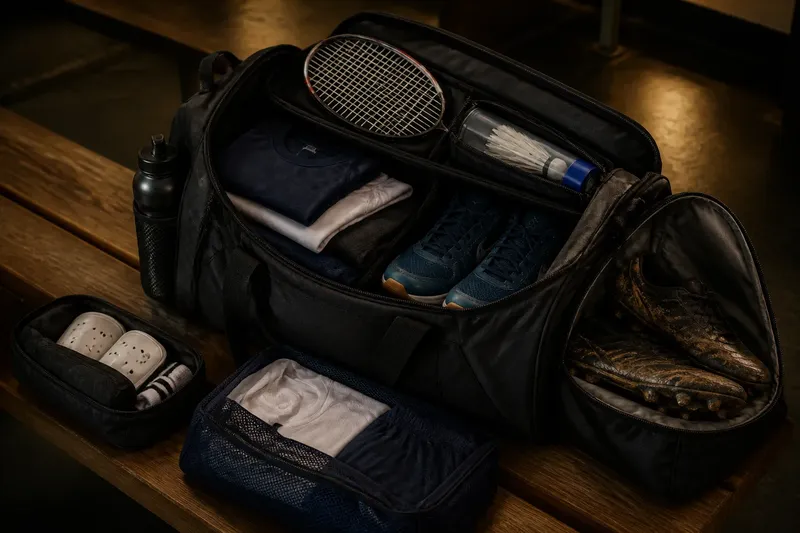
How do you choose a sports bag layout when a racket, muddy boots and clean clothes all need to travel together? A useful sports bag layout matches each item’s shape and the order you use it, rather than relying on pocket count alone.
Imagine Sam, a hypothetical club player switching between badminton and five-a-side football. Sam has one roomy duffel with a shoe pocket, a few zipped compartments and a large central space. After football, damp socks end up beside a clean shirt; before badminton, the racket presses against a bottle and the shuttlecock tube disappears beneath a towel. The problem is not that one bag must serve two sports. It is that each load needs a sensible route in and out.
Start with each kit
Sam lays out the equipment for each activity separately. The football kit includes boots, shin guards, socks, a shirt, shorts, a bottle and a towel. The badminton kit includes a racket, shoes, a tube of shuttlecocks, a shirt, the bottle and the towel.
Shape is the first difference. Boots are bulky and can carry dirt. A racket is long and should not be bent around other items. A shuttlecock tube is narrow and easy to lose among soft clothes. One compartment might hold all three, but that does not make them easy to find or protect.
Sam also notes what needs to come out first. At football, boots and shin guards are needed before play; the towel is useful afterwards. At badminton, shoes and racket come out early, while the shuttlecock tube should stay protected and visible.
Lay out one sport’s kit at a time and identify its awkward items before packing.
Match shapes to spaces
The racket needs a long, relatively straight route into the bag. A racket sleeve or separate compartment suits it better than a crowded main section. If the bag has no suitable space, Sam carries the racket separately rather than squeezing it among shoes and clothes.
Boots need a broad, contained space that keeps their soles away from clean kit. A ventilated shoe compartment can help if the boots fit without pressing on other contents. If it is too shallow, a washable boot bag can sit at the edge of the main compartment instead.
Small, easily misplaced items need a predictable home. Sam puts the shuttlecock tube and shin guards in a zipped pocket or removable pouch, rather than giving every small object its own compartment.
Check what an item might bend, crush, soil or leak against before assigning its place.
Plan access and separation
Sam puts the bottle in a side pocket that keeps it upright and easy to reach. It stays apart from the racket grip and clean clothing, where a leak could cause trouble. A small towel sits near the top because it may be needed before or after play.
For badminton, Sam loads the racket into its sleeve, places the shuttlecock tube in a protected, visible pocket, then packs shoes and clothes in the main section. For football, boots go in the shoe compartment or washable boot bag; shin guards and socks stay together so they can be picked up as a set.
The shared items keep familiar places, but sport-specific equipment gets a position that suits its shape and use. The bottle can stay on the side in both layouts; the racket does not need to share the boots’ space just to make the arrangements look alike.
Check the layout decisions
- Observe whether a racket fits without bending or pressing against hard objects; if it does, use its sleeve or straight compartment, and if it does not, carry it separately.
- Observe whether boots fit without compressing other kit; if they do, use the shoe compartment, and if they do not, contain them in a washable boot bag at the edge of the main space.
- Observe whether clean clothes touch muddy soles; if they do, add a separate clothes pouch or move the boots, and if they do not, keep the existing separation.
- Observe whether the shuttlecock tube is visible when the bag opens; if it is hidden, move it to a protected pocket or pouch, and if it is visible and secure, leave it there.
- Observe whether the bottle stays upright and apart from clothing; if it tips or leaks near clothes, use a suitable side pocket or carry it separately, and if it stays secure, keep its position.
- Observe whether frequently used small items are easy to retrieve; if they are scattered, group them in one removable pouch, and if they are already easy to find, avoid adding another compartment.
What should the layout answer?
Do I need a separate bag for each sport?
Not necessarily: one bag can work if equipment fits without being bent, crushed or mixed with unsuitable items. A separate bag or carrier makes sense if a long piece cannot travel securely or dirty kit repeatedly conflicts with clean gear.
Where should wet or muddy kit go?
Keep it apart from clean clothes in a ventilated compartment or a washable, closable kit bag suited to the item. Let gear dry promptly and follow the maker’s care instructions.
How many pockets are useful?
Use enough compartments to give small, frequently needed items a consistent home. If several tiny pockets make things harder to find, a single visible pouch may be simpler.
What if my equipment does not fit?
Work out whether the item needs more length, width or protection before trying to force it into the bag. Follow the bag and equipment makers’ instructions, and carry an incompatible item separately if needed.
Sam’s worked arrangement
Say Sam has the duffel, a racket sleeve, a washable boot bag, a fabric clothes pouch and one zipped pocket. These are invented details for a worked example. Sam starts with the badminton load: the racket goes into its sleeve, the shuttlecock tube into the zipped pocket, shoes and clothes into the main compartment, and the bottle upright in the side pocket. The result is that the racket has a straight route, while the tube remains easy to spot.
For football, Sam puts the boots into the washable bag and the clean shirt and shorts into the fabric pouch. Shin guards and socks go together in the zipped pocket, while the bottle remains on the side. The trade-off is that the main compartment has less room for loose items, but the boots no longer sit directly against clean clothes. If the loaded bag still presses on the clothes pouch, Sam can carry the boot bag separately rather than force the fit.
That arrangement makes the duffel useful for both sports without pretending every kit has the same needs. When choosing a sports bag layout, start with the longest, dirtiest and easiest-to-lose items; then give each a place that suits its shape and the order you use it.